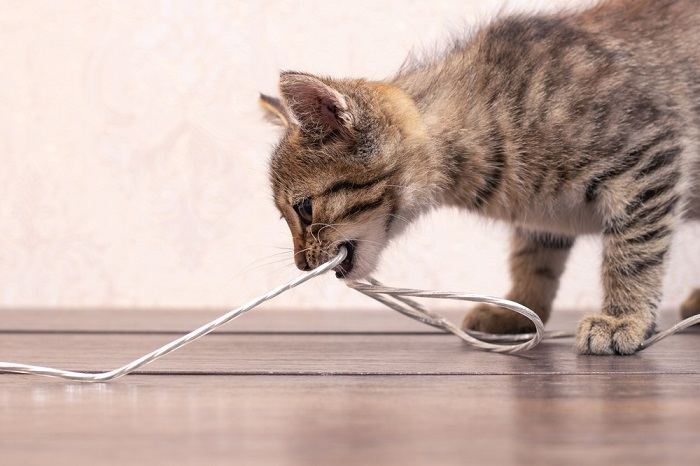
The thinner the cable, the more attractive it is to these beasts! This means cell phone charging cables and fiber optic cables are some of the most attractive to your kitten or cat.
I warn visitors that our kittens WILL bite through their charger cords if they leave them where they can get to them. And still, they get chomped. The first cable I will replace... the second, they have to buy their own!
So what do you do about this? The BEST solution is called split loom.

Split loom is a flexible plastic tube that is split along its length. It is used to gather and protect wires.
Note that split loom CAN be punctured by kitten teeth, but it is really hard to bite through. The best way to use it is to choose a size that is large enough to leave extra room around your cable. That way, the kitten may be able to puncture the split loom, but since the cable inside can move out of the way, the cable is not punctured or cut.
Installing the split loom can be troublesome. You need to be careful not to damage soft cables while putting them into the relatively sharp-edged split loom. They do sell tools for larger split loom to help put it on long cables. Look here for some tips on YouTube.
I've found that when kittens are young, I need to protect EVERY cable they can access. However, in my experience, older cats will usually ignore heavier cables like power cords, but your cats may be different. Power cords can be especially dangerous to a chomping cat, so be careful!
Below you can see I have protected all the easily accessible cables at my spouses workstation. Note that I have not left any cables dangling on the ground; they are all wound up and attached out of the way under the desk.
Behind the monitor:

Here is the back of the hubs:

Under the desk:

It seems like a lot of work, but if you do it well, you only have to do it once. After the cables are protected like this, we also also mist the cats with water if we see them looking to bite the cables. (But don't mist the cables or electronics!) They learn pretty quickly because the wrapped cables just aren't that attractive to bite anyway.
Just remember, your kitties are worth the effort!


